

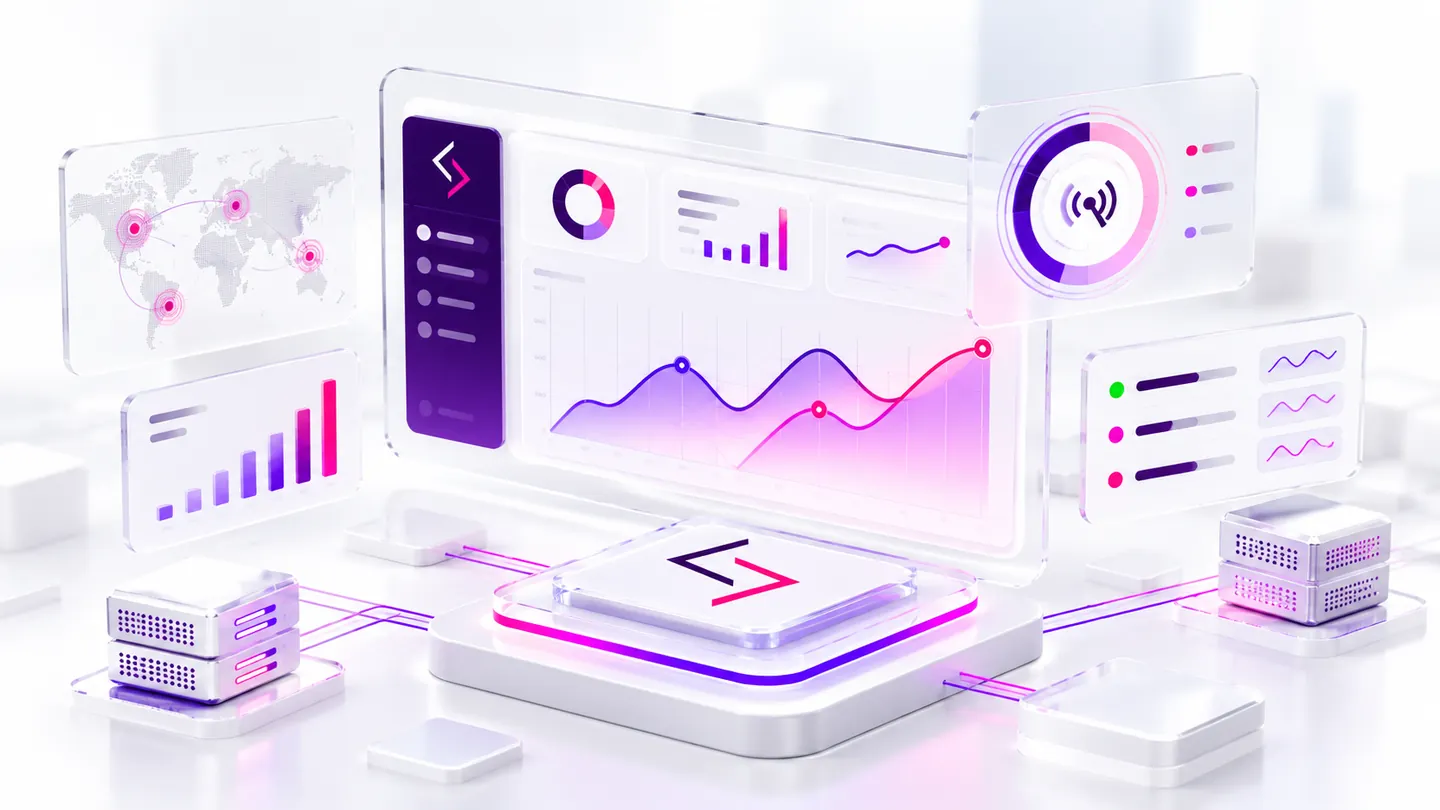

AI automation for broadcasters and ISPs in Nepal works best when it solves a specific operating problem: a missed on-air asset, an unresolved fiber fault, a delayed support ticket, or a disconnected billing workflow. Instead of replacing engineers and operators, well-designed automation helps them detect issues sooner, prepare decisions with better context, and complete repeatable tasks consistently.
Television stations and internet service providers may look like different businesses, but both depend on **always-on infrastructure, clear operational data, controlled change, and reliable customer service**. This guide describes ten realistic opportunities for AI-assisted workflows, how to connect them to existing platforms, and what to verify before implementation.
## What does AI automation mean in broadcast and ISP operations?
Traditional automation follows explicit rules: if a scheduled media file is missing, alert the operator; if a subscriber payment clears, update the billing record. AI can add contextual understanding—for example, classifying an incident from multiple alarms, extracting information from support conversations, or suggesting likely causes based on historical cases.
The strongest approach combines **deterministic controls for critical actions** with AI for analysis, summaries, classification and recommendations. A language model should not independently decide which video goes on air, change subscriber authentication policies, or disable a network port without validated authorization and safeguards.
## Five practical AI workflows for broadcasters
### 1. Playout schedule and media-readiness checks
Before a program reaches air time, an automation service can compare the approved playlist with the media asset inventory. It can flag missing files, unexpected durations, incompatible formats, absent graphics references, and scheduling gaps. An AI layer can group related alerts and draft a prioritized handover report. Final scheduling changes should remain under the control of the authorized operator.
**Pilot metric:** number of preventable last-minute media exceptions identified before transmission.
### 2. Broadcast monitoring and incident triage
Monitoring systems can collect black/freeze alarms, audio silence indicators, encoder status, transport-stream errors, and server health metrics. Rather than sending a flood of separate messages, AI-assisted triage can correlate alerts, propose the probable fault domain and summarize the evidence.
Important: silence and black frames can be editorially intentional. Critical switching decisions must rely on tested signal-health logic, not on a speculative AI summary.
**Pilot metric:** time from alarm to correct incident classification.
### 3. Newsroom, CG and metadata preparation
Newsroom teams frequently create versions of a headline for rundowns, tickers, lower thirds and social platforms. AI assistance can draft consistent variants, transliterate or translate carefully, and suggest metadata for media asset management (MAM) libraries. A producer or editor should approve every news claim and on-air graphic before publication.
For Nepali and English workflows, Unicode, name spelling and timing are particularly important. The CG engine should enforce safe areas, predictable layer behavior and operator-controlled preview/program transitions independently of AI.
### 4. Media asset search and archive discovery
Broadcasters often accumulate years of clips with uneven metadata. Transcription, content tagging and semantic search can help staff find relevant footage more efficiently. The workflow should retain asset rights, provenance, retention policy and editorial restrictions alongside any machine-generated tags.
**Pilot metric:** median time to retrieve a previously archived clip.
### 5. Maintenance summaries and shift handovers
A useful low-risk starting point is converting verified event logs, playout incidents, maintenance notes and resolved tickets into structured shift handovers. AI can summarize repeated problems and suggest which checks need human follow-up, while linking each claim back to an underlying log or ticket.
## Five practical AI workflows for FTTH and ISP operations
### 6. FTTH fault-ticket classification
Customer-reported 'no internet' incidents have many causes: optical power issues, local Wi-Fi problems, PPPoE/RADIUS errors, incorrect service profiles or upstream outages. AI can classify incoming tickets, detect duplicate reports from the same area and prepare a suggested troubleshooting sequence using trusted network evidence.
It should not infer an optical fault solely from a customer's message. Verify against OLT/ONT telemetry, link state, access logs and outage maps where available.
### 7. ACS and subscriber-device management
An Auto Configuration Server (ACS) using **TR-069/CWMP** can support device provisioning, status checks, configuration and maintenance for compatible customer-premises equipment. **TR-369/USP**, the Broadband Forum's evolution of TR-069, adds an architecture for broader device and service management, and can coexist with existing CWMP deployments.
AI-assisted support can use *approved* ACS/USP telemetry to identify patterns such as repeated reconnections or customer Wi-Fi complaints. Configuration changes, firmware rollouts and reboots should still require device compatibility checks, scoped permissions, rollout controls and rollback planning. See the [Broadband Forum's USP guidance](https://usp.technology/) for protocol details.
### 8. AAA, RADIUS and session investigations
Authentication, Authorization and Accounting (AAA) are central to many ISP access environments. RADIUS records can help support teams understand denied sessions, expired plans and session usage. AI can assemble a chronology across subscriber management, authentication events and network alarms so engineers can investigate faster.
RADIUS accounting, documented by [RFC 2866](https://www.rfc-editor.org/info/rfc2866/), carries accounting information between network access and accounting systems. Treat logs as sensitive operational data: redact credentials and subscriber identifiers before sending them to external models, and limit access by role.
### 9. OSS/BSS, CRM and billing reconciliation
An ISP may run separate systems for orders, customer records, provisioning, usage, payment collection and support. A supervised automation workflow can detect mismatched account statuses, missing provisioning acknowledgements, unresolved service orders or failed payment reconciliation. AI can group anomalies and draft explanations for staff.
Keep the authoritative record in the OSS/BSS database, not in a model response. Financial adjustments, suspension decisions and provisioning changes must use validated business rules, audit logs and approval thresholds.
### 10. Customer support and field-work coordination
A support assistant can retrieve approved answers, summarize the customer's troubleshooting history and prepare a technician dispatch checklist. With appropriate consent and privacy controls, it may also produce Nepali- and English-language guidance. Escalation to a human should be easy when the case is urgent, sensitive or outside the assistant's verified knowledge.
**Pilot metric:** first-contact resolution or repeat visits, measured with comparable issue types rather than simply counting automated replies.
## Reference architecture: connect before you automate
A practical architecture contains five layers:
1. **Source systems:** playout, MAM, NRCS, CG, alarms, OLT/NMS, ACS/USP, AAA/RADIUS, CRM, billing and ticketing. 2. **Integration layer:** authenticated APIs, webhooks, event streams or approved read-only database views, with normalized identifiers and timestamps. 3. **Policy and workflow engine:** deterministic checks, role-based permissions, validation, incident thresholds, approval requirements and rollback procedures. 4. **AI assistance:** retrieval from trusted operational knowledge, classification, anomaly grouping, drafting and explanations with cited evidence. 5. **Operator interface:** dashboards, ticket queues, human approval, audit trails and incident reporting.
Start with **read-only analysis**. Add actions only after replay testing, staged rollout, permissions review, measurable outcomes and a documented failure path. Where systems lack suitable APIs, budget for integration work instead of assuming that a generic AI chatbot can safely operate equipment.
## Data security and AI governance
Operational telemetry, subscriber details, program schedules, customer conversations and access-control logs may be confidential. Define data minimization, access roles, retention periods, encryption, incident response and vendor boundaries before connecting them to any model. Validate generated claims against source records, and establish manual fallback procedures when the AI service is unavailable.
The [NIST AI Risk Management Framework](https://airc.nist.gov/airmf-resources/airmf/5-sec-core/) provides a helpful structure around governing, mapping, measuring and managing AI risk. In mission-critical broadcasting and telecom, accountability and human oversight remain engineering requirements—not optional extras.
## How to launch a 30-day pilot in Nepal
**Week 1 — Discover:** choose one repetitive, measurable workflow; identify data owners, interfaces, failure modes and approval points. Capture a baseline.
**Week 2 — Integrate:** connect a limited dataset using read-only permissions, clean the records, and define the outputs that an engineer or operator can independently verify.
**Week 3 — Test:** compare AI classifications and summaries with expert decisions. Record false positives, missed cases, privacy risks and workflow friction.
**Week 4 — Evaluate:** review time saved, quality, operational risk, staff feedback and infrastructure cost. Expand only when results justify the investment.
Small pilots often generate more reliable evidence than a large 'AI transformation' project without clear ownership or acceptance criteria.
## Frequently asked questions
### Can AI automatically control a 24/7 TV playout system? AI can support scheduling checks and incident triage, but on-air changes should be executed through approved automation and operator controls with independent safety checks.
### Can AI replace an ISP's ACS or RADIUS server? No. AI is an assistance layer. ACS/USP and AAA/RADIUS perform defined provisioning, management and access-control functions that still require their own reliable platforms and policies.
### Does an ISP need TR-369 to begin automation? Not necessarily. Existing TR-069-compatible deployments may offer useful telemetry and management capabilities. TR-369/USP can be evaluated based on device support, integration requirements and migration planning.
### How can small providers start without a large budget? Begin with one narrow, read-only workflow such as support-ticket categorization or daily alarm summaries. Measure the outcome before investing in wider integrations.
## Build connected operations with Simulcast Technologies
[Simulcast Technologies Pvt. Ltd.](https://www.simulcast.com.np/) works across broadcast engineering, software development, AI-assisted automation, IT systems and telecom-related integration. If your goal is to connect broadcast playout and monitoring, improve ISP subscriber operations, or design a custom OSS/BSS workflow, begin with a technical discovery session covering your existing platforms, required interfaces and support responsibilities.
Explore the company's [broadcast solutions](https://www.simulcast.com.np/solutions/broadcast-media) and [AI automation services](https://www.simulcast.com.np/solutions/ai-automation), or email **info@simulcast.com.np** to discuss your requirements in Nepal or beyond.
*Technical sources: [Broadband Forum USP](https://usp.technology/), [Broadband Forum TR-069](https://www.broadband-forum.org/public/certifications/bbf-069-certification/), [IETF RADIUS Accounting RFC 2866](https://www.rfc-editor.org/info/rfc2866/), and [NIST AI Risk Management Framework](https://airc.nist.gov/airmf-resources/airmf/5-sec-core/).*
*Featured-image alt text planned for publication: “AI automation for broadcast playout, FTTH networks, ACS, AAA, ISP management, school software and OSS/BSS in Nepal — Simulcast Technologies.”*